13 March 2003: From CWI
Online
US war marks a new world era
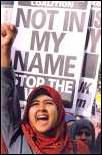 The mass movements against war and the power
struggles between and within the different ruling classes over the last
few months have produced one unprecedented event after another.
The mass movements against war and the power
struggles between and within the different ruling classes over the last
few months have produced one unprecedented event after another.
Below, in ten points, is an edited version of
an article by Per-Åke Westerlund, which looks at the new world era
ushered in by US imperialist aggression and war.
This article first appeared from the journal of
the Socialist Justice Party (on 13 March 2003), the Committee for a
Workers' International affiliated Swedish party.
'Breaking with the past' – Ten points on the new world era
1. The Bush 'doctrine'
This doctrine, introduced a year ago, explains a new world-view
within the US ruling class. That is, US power should never be
challenged. For this, Washington reserves its right to pre-emptive
military attacks. The development towards this position was clear even
under Clinton, but took definite shape after the September 11 terror
attacks.
Actually, the unilateralist position of the US is a belated
recognition of the collapse of Stalinism from 1989-91 and of the extreme
military and economic dominance of the US compared to other powers.
In the war debate over Iraq, this line is expressed in statements
that the US can fight a war without the UN, without troops in Turkey,
and even without British support, as Rumsfeld put it. The war is planned
against the position of the allies of the US and of course against the
public will of the regimes in the Middle East.
The driving political force in the US ruling class is, according to a
recent article in the Financial Times, an alliance of
"nationalistic conservatives" and
"neo-conservatives". The former, represented by Vice-President
Cheney and Defense Secretary Rumsfeld, aim to smash the enemy, while the
latter, represented by Deputy Defence Secretary Paul Wolfowitz, seek to
'reshape' the enemy. The 'neocons' – also named 'democratic
imperialists' or 'liberal imperialists' – play an increasingly
important role within the administration. Wolfowitz & Co. are united
with Cheney in their contempt of the UN and multilateralism, and on
heavily increased arms expenditure. But the 'neocons' differ in their
willingness to engage in 'nation building’, which now includes Iraq.
In another FT article, Philip Stevens refers to discussions with a
top civil servant in the Bush administration. This representative echoed
what Marxists said at the time of the collapse of Stalinism, that the
'glue' holding the 'Western camp' together is now beginning to dissolve.
Never once did the high ranking official refer to 'US leadership', only
to 'US primacy'. In this context, it is up to the European governments
if they want to act together with the US or not and that will determine
whether they are 'relevant' or not. The Bush doctrine constitutes a
clear break in capitalist world relations, particularly between the US
and Europe.
2. Broken alliances?
The new period has meant a shake up of old alliances. One of the most
reliable US partners over the last 50 years, Germany, is now in the
other camp in the power struggle. Of course, France and Chirac have a
higher profile as a military power, but Germany is potentially a more
important challenger to the US.
This tendency is strengthened by the fact that President Putin of
Russia seems to have opted for the "old Europe", instead of
the US, as a more important partner. These new splits or beginnings of
splits are caused by both economic factors and the struggle for
political influence and are as a result of pressure from the mass
protests.
Placed at the cutting edge of most of the new conflicts is the
British ruling class. With a rebellion of Labour MPs and even government
ministers, close advisors to Blair warn that he can be overturned within
days or weeks. The choice between supporting the US or take a leading
role in the EU is, at this stage, no real choice, since the EU is
completely split. The split with France represents the sharpest
British-French conflict for almost 50 years, and an important factor in
possibly bigger problems for the EU.
3. The strength of mass power and the weakness of the ruling classes
The weakness of the capitalist classes is striking. The governments
in Britain and Spain, which are supporting Bush’s war, are totally
isolated. In France, those capitalists which fear a break with the US
have insufficient strength to challenge Chirac. In Sweden, the Social
Democratic government has swung from sharp criticism of Schröder to
opposing the new US/UK resolution at the UN. This is clearly an effect
of the mass demonstrations and protests against war, as are most of the
problems facing Bush and the Whitehouse Administration's hawks.
The US war plans follow from the economic role of the US and the mass
movement against war is a continuation on a higher level of the movement
against capitalist globalisation. This relatively new and mixed mass
movement has grown to historic proportions - one of the biggest
movements ever. The protests and the hope for a 'new world' made by many
protesters go far beyond the war question. Sharp criticism of
governments' general policies and capitalist exploitation is a common
feature of the demonstrations.
The movements can lead to new political formations, but they also,
more importantly, show a glimpse of the role of the organised working
class. With fighting trade unions and new mass workers' parties, armed
with a fighting socialist programme, we would see a movement dwarfing
anything we have seen so far.
4. The crisis of the EU
"Foreign policy is the continuation of domestic policy",
was a saying of General Clausewitz, which Marxists often use. But it
works the other way around as well. The sharp conflict over Iraq between
the EU governments will inevitably continue over other issues. Also for
economic questions – the recession in Germany and other countries –
contradictions will grow.
The struggle at the 'top', however, is not between Left and Right or
even between war and peace. The Communist Party and the Socialist Party
portray France’s President Jacques Chirac almost as a peacemaker. But
the fact is that France at the moment is heavily increasing expenditure
on both the military and the police. At the same time, attacks on
workers' rights, privatisations and the public sector continue.
The French attempt to retake a leading role in the EU, in alliance
with Germany, has failed. The candidate governments ("New
Europe") in particular want a link to the US. This will act, the US
hopes, as a counterweight to Germany and France. Spain and Britain are
the main opposition to France on issues like deregulation and the
adoption of the economic 'model' of the US. Other governments support
the French/German position, completing the split in the EU.
The EU governments will attempt to paper over the divisions. But they
find they are in a weaker position in comparison to the US. The EU
states also need the EU for further economic reasons, to, for example,
carry through new attacks on the welfare state. The EU also plans to
carry out the enlargement process. But at the moment, the EU has entered
its biggest ever crisis.
5. The end of the UN?
According to the Bush administration, the 'relevance' of the United
Nations depends on whether if supports the war or not. The US is
prepared to go to war. It has shown it was also quite prepared to go to
war even if a veto against war was used on the Security Council. Such an
historic event - the US did not override 106 Soviet Union vetoes in the
period 1946-65 - would, according to UN secretary General Kofi Annan,
mean a breach with UN statutes.
Can this mean the end of the UN? Those who see the UN as a 'world
government' or a 'tool for peace' enormously exaggerate the role of the
UN. Since its foundation the UN has mainly either been a paralysed club
for debates or a tool for the US. Nevertheless, illusions in the UN will
now increasingly be undermined, either by its support for a US war, or
by its total neglect by the hyper-power.
6. Turkey - political chaos
Today's political turmoil in Turkey differs from earlier ones in at
least one respect. When the Turkish parliament voted to block 60,000 US
troops entering the country, it meant a serious rupture in the alliance
between the US and the Turkish elite. The Bush administration then
demanded an explanation and finally tried to belittle the problem. Now
it is unclear whether even the ruling Justice and Development party (AKP)
leader Erdogan, elected MP last week, and now Prime Minister, can turn
the vote round in parliament. Whatever the outcome, it could mean splits
in the AKP or its dissolution.
The Kurdish people are now in the spotlight. Mass demonstrations in
northern Iraq (south Kurdistan) have taken place, not against Saddam,
but against Turkey. The Kurdish masses fear a Turkish invasion of Iraq.
The Turkish leaders, on the other hand, fear any form of independent
action from the Kurds in Iraq.
Another difference from previous crises in Turkey is that the
military do not seem to be able to intervene. Instead, the generals have
relied on the 'Islamic reformers' of the AKP to enable the presence of
US troops on Turkish soil. It is the mass opposition against war (well
over 90% according to polls) and against the economic and social crises,
which are the dominant factors at the moment. This could, depending on
the outcome of the war, lead to new social explosions and workers'
struggle, as well as renewed struggle from the Kurds in Turkey.
7. Day X
This week, even the tame Swedish trade union federation, LO, has
spoken of a possible strike on Day X, if the Security Council votes
'no'. This, if anything, indicates that the outbreak of war will lead to
the biggest anti-war protests ever seen, including workers' strikes and
gigantic demonstrations. Politically, this could lead to mass defections
from the Labour Party in Britain and a sharp drop in support for any
party connected to the war. Longer-term consequences will depend on the
war itself.
8. The war
The Turkish 'no' vote has severely affected US war plans. Northern
Iraq is important because of the oil fields, the Kurdish mass discontent
and a strong presence of Saddam's Republican Guard in that region. The
USA war will probably now, more than originally planned, rely on the
bombs and artillery of the air force.
Most 'experts' believe in a short war, which is quite likely because
of the massive military superiority of the US. But there can be all
sorts of unknown factors prolonging the war, from chemical weapons to
street-by-street fighting in Baghdad. The war will in any case provoke a
new peak in anti-US moods, particularly in the Middle East.
9. Nation-building and occupation
The neo-colonialist aims of US imperialism are clear from their plan
to rule a post-Saddam Hussein Iraq by a military governor (US general
Tommy Franks). The once praised Iraqi exile opposition groups are at
best in the backseat, as far as Washington is concerned. This has led
them to openly criticise the US, with some of them even talking of going
into opposition the day the war starts. Kurds and Shia Muslims will get
no improved rights in US-run Iraq.
According to one analysis of the US role in overthrowing regimes,
only 5 out of the 18 regimes 'installed' by the US became 'democracies'.
They have generously counted three cases from World War II into this
category: Germany, Italy and Japan (!), plus Grenada and Panama. In the
most well known cases – Chile, Iran, Iraq and Jordan – the US
installed new dictatorships. Most parallels, however, are drawn with the
fiasco of the new regime and state in Afghanistan, or with Sharon’s
policies towards the Palestinians.
Any occupation aimed at 'nation-building' will be long. Just look at
the situation in the Balkans, where even pro-imperialist commentators
say that they have only just begun the task of nation building. There
are even commentators who speculate that the US might have to withdraw
from nation-building in Iraq, and retreat back to 'Fortress US'. The
military strength of the US is not matched by a corresponding political
weight or the resources needed for real 'nation building'.
10. US role and new forces
The US entered a period of wars, under the framework of a so-called
'war against terrorism'. Next after Iraq could be the turn of Iran or
North Korea, both probably much more complex and difficult scenarios for
the US power to deal with.
The world has entered a much more violent and explosive period. A
cycle of bloody conflict has opened up. US imperialist aggression is
provoking conflict and turmoil. This will undoubtedly provoke some
desperate youth in the neo-colonial world to pursue the dead end of
individual terrorism. New terror attacks could be used as a pretext to
wage new imperialist wars. 'Rogue' regimes may try harder to get hold of
weapons of mass destruction to defend them from US imperialist
aggression.
There is no superpower counterweight to the US. A continuation of the
movement against war, to a higher political level, is only possible if
it develops into a clear working class led movement.
The role of socialists and Marxists is both to organise the mass
movement, particularly youth and workers, and to help build new mass
workers' organisations to change society fundamentally, putting an end
to capitalist wars, oppression and exploitation.
