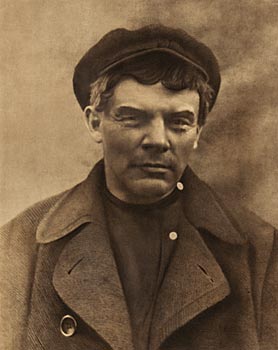
Picture: Lenin in disguise in 1917
Home
| News | Donate
| Join
Introduction
A young South African activist, 20-year-old Comrade Bongani of the
underground movement in Tumahole township, reflects the attitude of
serious fighters the world over towards the need for socialist theory.
Asked by a journalist what "people's education" meant, he is reported with
answering:
"I mean the type of education whereby all the people are satisfied with it
because they are involved in the decision-making for the benefit of all.
"For instance, when dealing with the Russian Revolution of 1917, because
Russia is a Communist country, Bantu education [discriminatory system of
schooling imposed on blacks by the South African state] will tell you this
and that about communism and how bad it is.
"They won't tell you the true facts about what happened in Russia during
that time..."
"Would you like to see socialism in this country?"
"Yes, because it's going to do away with capitalism."
"What do you understand by capitalism?"
"It is a system of private ownership by certain individuals who own the
means of production. My parents, from Monday to Friday, can make a
production of R1,000, but he or she is going to get, say, R50. So our
parents are being exploited so that certain individuals can get rich.
"That's why I prefer socialism, because the working class will control
production." (Financial Mail, Johannesburg, October 31, 1986)
It is not accidental that this comrade should use the example of the
Russian revolution to illustrate this point. The first (and so far the
only) conscious socialist revolution in the world, it proved irrefutably
the possibility of overthrowing the rule of the reactionary classes and
establishing the rule of the working class.
Despite systematic distortion by the capitalist media and education
system, workers, youth and peasants (especially in the underdeveloped
world) are aware of Russia's amazing transformation, following the October
revolution, from a backward peasant country into a superpower.
For these reasons the Russian revolution has continued to inspire millions
of oppressed people with confidence in their own victory. For the same
reasons, no other event contains more fundamental lessons for the
working-class movement today.
What are the "true facts about what happened in Russia during that time?"
On what program did the Russian working class conquer power? Are the
fundamental aims of that program still applicable in our struggle today?
Comrade Bongani refers to Russia as a "Communist" country. To what extent
has the program of the 1917 revolution been carried into practice? To what
extent has Russia advanced towards communism?
Politically conscious workers are aware that serious problems exist in the
Soviet Union. In 1956, Soviet leader Krushchev denounced the monstrous
corruption and repression that had characterized the rule of his
predecessor, Stalin, from the 1920s until his death in 1953. Thirty years
later, Mikhail Gorbachev is denouncing the continuing bureaucratic abuse.
Comrade Joe Slovo, leader of the South African Communist Party, today
expresses his "anger and disgust" at having been a defender of Stalin's
regime. (Interview with The Observer, London, March 1 1987)
But denunciations, anger and disgust do not answer the real question: what
happened in the Soviet Union after 1917 to give rise to a regime of mass
repression? Seventy years later, what remains of the system of workers'
democracy established under the leadership of Lenin and Trotsky?
For socialists it is essential to answer these questions fully and openly.
Our critical examination of the Russian revolution and its subsequent
degeneration has nothing in common with the capitalists' class hatred
towards the USSR. We need to know "the true facts" in order to learn the
lessons, and to respond correctly to the policies of the present-day
Soviet leadership.
Comrades should organize discussions where these events, and the ideas
that explain them, can be analyzed, where queries can be raised and ideas
debated. This pamphlet is intended as a contribution to the discussion,
and an introduction to further reading.
Each of its four parts, for example, could form the basis for a group
discussion. Individual comrades could prepare contributions on the topics
(sections) into which every part is divided. The books and pamphlets
listed at the end should be studied by comrades who want to understand the
issues in more detail.
Carrying out this study, and taking on board the lessons, is the best way
to commemorate the anniversary of the Russian revolution.
George Collins, October 1987
Continue ...
Home
| News | Donate
| Join
|
